
Treatment Categories

Enemas

<p><strong>Enemas</strong> are medical treatments used to relieve severe constipation and prepare the bowel for medical procedures. They work by introducing a liquid solution into the rectum, which softens hardened stool and stimulates bowel movements. Enemas are typically recommended when other laxatives have not been effective or when rapid relief is needed.</p><p>The most commonly prescribed enema treatments include Arachis Oil enemas, which use a natural oil-based solution to soften and lubricate impacted faeces, making them easier to pass. These are particularly useful for patients with chronic constipation or those who have difficulty with oral laxatives.</p><h3>When enemas are recommended</h3><p>Enemas may be recommended by a healthcare professional for conditions including faecal impaction, severe constipation that has not responded to oral treatments, and as bowel preparation before certain medical examinations or procedures. They should be used under medical guidance to ensure safety and effectiveness.</p><h3>Online consultation</h3><p>You can access enema treatments through an online consultation with an EU-registered doctor. After completing a detailed medical assessment, a qualified physician will evaluate your symptoms, medical history and suitability for treatment. If approved, your prescription is sent to a certified pharmacy for discreet delivery directly to your door.</p>

1 available treatments

Understanding Enemas and Severe Constipation — Your GP's Guide

<p>Many of my patients come to me feeling incredibly embarrassed, anxious, and physically uncomfortable when dealing with severe bowel blockages. Please know that as a GP, I see this issue almost every single week. Constipation is a universal human experience, and sometimes it reaches a point where standard oral medications simply cannot break through from the top down.</p><p>An enema is a highly effective, targeted liquid treatment introduced directly into the rectum. It is designed to soften, lubricate, and gently flush out stubborn stool that has become lodged lower down in your bowel. While the idea of administering one at home might feel daunting at first, it is a straightforward procedure that can provide profound relief.</p><p>I want to reassure you that you do not need to suffer in silence or wait for things to resolve on their own. With the right guidance and treatment, we can clear the blockage safely and comfortably, allowing you to get back to feeling like yourself again.</p>

Treatment Guide

Available treatment options

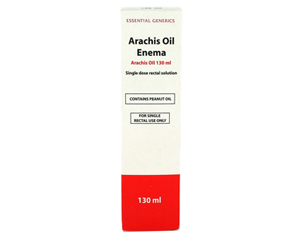
When it comes to clearing a hard impaction, lubrication is often more effective than simply adding fluid volume. This is why I frequently recommend an Arachis Oil Enema .

It contains peanut oil, which coats the hardened stool, softens it, and lubricates the bowel lining, allowing the mass to slide out with much less straining. Of course, because arachis oil is derived from peanuts, it carries a risk of anaphylaxis for those with nut allergies.

For those patients, we rely on alternatives like saline or phosphate enemas, which draw water into the bowel to flush it out. However, for sheer softening power of rock-hard stool, oil-based enemas are typically my first line of defence.

What to expect from treatment

Realistic expectations are key to a successful enema. Unlike micro-enemas that work in 15 minutes, an oil retention enema is a slow process. It usually needs to be held in the bowel for 1 to 3 hours, or ideally overnight, to properly penetrate the stool.

Here is a crucial clinical pearl that is rarely written on the box: always warm the enema slightly by placing the sealed bottle in a bowl of warm (not hot) water for ten minutes before use.

Administering cold liquid into the rectum causes instant muscle spasms and an overwhelming urge to evacuate immediately, long before the oil has had time to do its job.

A body-temperature liquid is much easier to retain.

Self-care and prevention

Once we have cleared the blockage, prevention is vital. Beyond the standard advice of drinking two litres of water daily and increasing dietary fibre, the physical mechanics of how you sit on the toilet matter immensely.

I always advise patients prone to impaction to use a small footstool in the bathroom. Elevating your knees above your hips straightens out the puborectalis muscle, which normally acts like a kink in a garden hose to keep you continent.

Straightening this anatomical kink reduces the need to strain and helps prevent stool from pooling and hardening in the lower rectum in the future.
Frequently Asked Questions

Medically reviewedDr. Claire Phipps(GMC: 7014359)

A Doctor's Guide to Using Enemas Safely at Home

Important: Prescriptsy connects you with independent, EU-registered doctors. We do not sell medication directly. All treatments are prescribed by a doctor and delivered discreetly to your door.